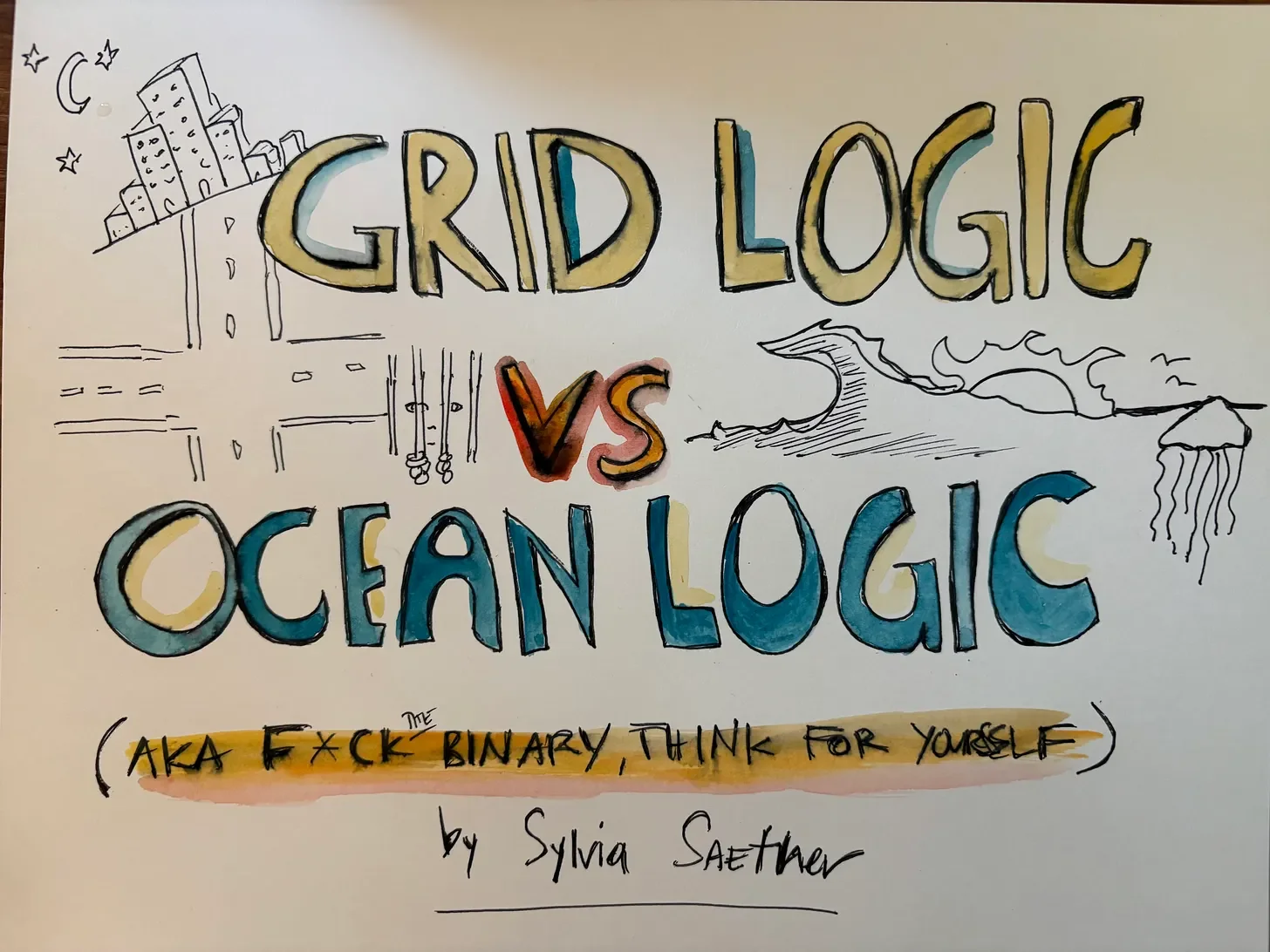
Grid Logic vs. Ocean Logic (f*ck the binary, think for yourself)
Why I Don’t Trust “Truth” or People Who Think They Know Everything
Another thinker who influences me daily, especially around the topic of being okay with not knowing is Michel Foucault.
Fuck I love this French philosopher and historian.
I know some people aren’t fans, especially some feminists. But I’ve always had the ability to take what works and leave the rest—and what works about this dude’s way of thinking is fucking genius.
For the record, many feminist’s have critically challenged, engaged, added to, and remixed his ideas with their own work. People like Judith Butler, Donna Haraway, bell hooks, and Angela Davis. I mean, that’s what we do— add to the conversation but give credit where credit is due.
When my dear friend (and someone I deeply admire) Dr. Tripp introduced me to Foucault (and so much more), two things happened:
A.) This weirdo suddenly felt seen, heard, understood and validated like I never had before.
B.) My ability to critically think and wade through multiple truths exploded to new levels.
I was already trying to push myself out of binary, black-and-white, good/bad style thinking. But then Dr. Tripp and Foucault came along and the world became kaleidoscopic.
Okay first, let’s define this thing I like to call grid logic (aka binary thinking) as the invisible architecture that tells us:
- You're this or that.
- This is normal, that is other.
- This is true, that is false. Right, or wrong. Good or bad.
- Choose a box—or we’ll choose one for you.
Grid logic is how we make people legible to systems by flattening their complexity into categories that feel safe, but often erase them.
Foucault’s work exposed grid logic for what it is: a power tool disguised as common sense. What looks like “just the way things are” is often the result of centuries of categorization, control, and conditioning.
Grid logic hides in plain sight. It shows up in the DMV form that asks you to check one box for gender. In the classroom that measures intelligence by standardized tests (fuck standardized tests I could write a whole thing on that.) In the medical system that pathologized homosexuality and neurodivergence. In every “normal vs. deviant” binary we’re told is objective truth.
Foucault wasn’t just interested in what power does, he was obsessed with how power hides. He also argued that power doesn’t only work top-down (government/corporate america → people), but circulates through our beliefs, language, bodies, and institutions. It’s a web and we’re all trapped in it. And the most effective power doesn’t need to be enforced violently, it just needs to feel natural.
For instance, when we are signing up for instagram (or the like) and I ignore the “rights of use/terms of agreement” or whatever and just click it—I’m trading my privacy/certain rights for the pleasure or value of whatever that app/thing gives me.
That’s totally normal, right? I mean, everyone does it? Yes. And no. This is one of a million ways we all end up participating in our own subjugation and oppression. The list of examples are endless but I won’t unpack all that today.
That’s the trick of grid logic: it feels like common sense because we’ve internalized it. So deeply, in fact, that we often police ourselves and each other without realizing it. Cancel culture? Another example of us policing each other. It’s fucking genius.
But there’s this quote from Foucault that I always come back to:
“Knowledge is not for knowing: knowledge is for cutting.”
It captures a central idea in his philosophy: knowledge isn’t neutral or purely contemplative, it’s a tool of power and intervention.
Foucault’s method of genealogy is a way of using knowledge to cut through historical layers of assumptions and institutions, showing how so-called “truths” were actually constructed.
So for him, knowledge isn’t a mirror of reality—it’s a critical scalpel.
NOT A MIRROR OF REALITY.
(I’m not yelling at you—just emphasizing how important that is.)
And it’s not about confirming or justifying systems as they are—it’s about disrupting and dissecting them.
Foucault is also calling bullshit on the idea that knowledge is objective or innocent. Every act of knowing comes from somewhere. It has a position, a perspective, and usually, a will to order or control.
We see this play out on the micro level inside our own subconscious patterns, in how we relate to others (partners, kids, coworkers, etc). And on the macro level in the way governments, institutions, advertising, media, etc function.
Basically: knowledge is not about passive contemplation or the pursuit of abstract truth. It’s an active, strategic force that shapes reality by creating distinctions, categories, and systems of power. It dissects the world—and in doing so, it often controls it.
Many have argued that words and language shape reality through the meaning we make with them—and the power we give them. Take the word “normal.”
Who gets to decide what the fuck normal even means?
Who does that definition benefit?
Who does it hurt?
Same with constructs like race—invented categories that were socially constructed (for horrific and obvious reasons) and have real and lasting impact. They are fake and real all at once because that made up thing still carries real consequences on bodies, minds, and hearts. It literally erases and murders them. (Trans friends I love and support you.)
The world would love for you to believe that something is just “right” or “normal,” when in fact, those ideas are manufactured. Not to mention used to divide, control, and conquer.
The more innocent version of why we slip into this grid logic style thinking all the time is that our overstimulated minds simply want quick orientation and fast fixes. It’s easier to say “this is good, that’s bad,” or “I like this, I don’t like that,” than to pause and deconstruct the roots of those reactions and choose a response versus knee jerk reaction.
But when we go deeper, when we challenge and dismantle those automatic thoughts and actions and an entire world opens up. We start unplugging from the matrix. I’m not saying that’s painless. Or easy. But at least it’s fucking real. And at least you’re trying to think for yourself.
It has helped me to think of not-knowing not as a weakness, or being confused, but as resistance to manipulation—and as an act of freedom. It shows a flexible mind. Humility. An open heart. A willingness to be changed. Life is endless change and we know it. Fight it or flow with it, we get to decide.
Practicing being cool with not-knowing also helps me get off my own ass about things I’ve been brainwashed to think I should or shouldn’t be doing. You all know that this world would have us working night and day to produce and survive, if we let it.
Ideas of what’s productive or not are conditioned into us from childhood. And they are actually total garbage, and again, a means of controlling us and making us good obedient worker bees and consumers. More on that another time—but let me be clear— fuck that.
It’s easy to see, especially right now, that the world is ass-backward and insane in soooo many ways. A lot of people think that admitting you don’t know something is a weakness. But it’s actually a superpower.
Just like tenderness or vulnerability which are often mistaken for weakness, but are in fact consciously chosen ways of being rooted in authentic power and grit. They actually require more courage from us.
Okay, so what’s the alternative to grid logic you may be wondering?
It has many names, but I’m currently vibing on ocean logic to describe this alternative way of being and thinking. It’s inspired by a lot of brilliant people’s ideas— and I like that it centers mother-nature as knowing what-the-fuck-is-up, and us as being connected to that. I mean— we are it. A part of it.
Now I hear you now asking, “Okay, okay, Sylvia but WTF is ocean logic?”
Great question.
First, let’s revisit what Grid Logic is trying to do.
Grid Logic wants to make sense of you before it lets you exist. And in doing so, results in policing who gets to belong.
It is:
Rigid: thinks in rows and columns, boxes and labels
Binary: either/or, good/bad, true/false
Controlling: aims to predict, define, and contain
Constructed: built from systems of power
Flattens: complexity becomes illegibility or deviance
Disembodied: intellect over instinct, abstraction over experience
Linear: progress is forward, logic is rule-based
Alternatively…
Ocean Logic doesn’t need to name everything to trust it’s real. It makes space for difference without needing to control it.
It is:
Fluid: accepts shifting tides, contradiction, and depth
Non-binary: both/and, neither/nor, mystery allowed
Surrendered: moves with currents rather than against them
Organic: arises from intuition, emotion, lived experience
Expansive: makes room for the unknown, the unseen, the felt
Embodied: rooted in sensation, presence, and somatic truth
Cyclical: honors patterns, rhythms, nonlinear unfolding
Grid logic is what the powers-that-be use to divide us and this “every person for themselves” shit.
Ocean logic reminds us we’re interconnected and interdependent.
Grid logic gives you rules to follow. Asks you to look to external authority. It also keeps you stuck in your thinking/head/mind trying to “figure” things out.
Ocean logic asks if it feels right in your gut. Teaches you to trust your inner authority. It helps you get into your body. To flow with change and trust the unfolding process.
Ocean logic is another way of expressing Bruce Lee’s philosophy “Be like water” and the Tao Te Ching, especially verse 78, which I imagine Lee was also influenced by and goes like:
“Nothing in the world
is as soft and yielding as water.
Yet for dissolving the hard and inflexible,
nothing can surpass it.
The soft overcomes the hard;
the gentle overcomes the rigid.
Everyone knows this is true,
but few can put it into practice.”
Or what Kung Fu in general teaches you about redirecting energy and flowing with what is. This is how women monks at the Shaolin temple could defend themselves against the government forces/men technically a million times stronger than them in brute force. Strength and size didn’t matter when they learned to befriend and use the energy within them.
This style of Kung Fu is specifically called Wing Chun (means Beautiful Springtime) and was created by a Buddhist Nun who combined all the deadliest moves from traditional Kung fu. Bruce Lee’s style, Jeet Kune Do has a lot of inspiration from this one.
Point being
You learn to use the mind as the tool is was meant to be and that requires flexibility and spaciousness. I truly believe that learning how to wade in the unknown, and hold multiple truths at once without demanding a fixed answer is essential to any future on this planet that includes freedom, equity and equality for us all.
When we stop thinking we know we start to listen— and learning to listen can shift everything.
So when you look out into the madness, or feel overwhelmed by the news, and find yourself wondering how you can help make real and lasting change in such a lost and violent place—here is a way to consider.
And what’s rad is that it costs zero dollars and you can begin practicing right now.
Friendly reminder: